Also ask someone who knows you well to select the descriptions they think sound like you. On what side have you selected more descriptions?
Now select from the following additional descriptions.
Here are some ideas of the careers these interests could lead you to.
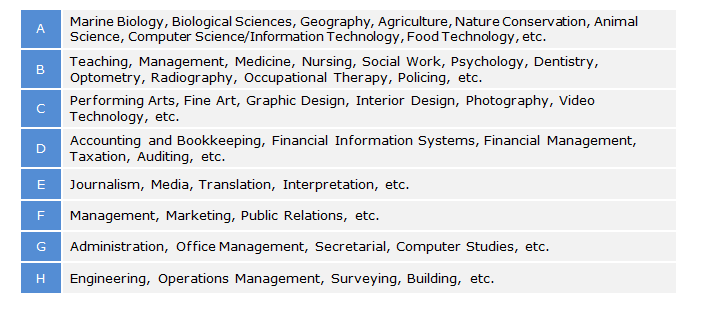
Certain types of people match certain types of careers. Sometimes parents, friends or your community may try to push you towards a career that you know youre not right for. Sometimes your friends are all studying something – so you feel you should too. Other times you hear that you might get a bursary for a certain course and this makes you want to choose it. Be careful, as you will spend a large amount of your life working… and working in the wrong job can be stressful and unfulfilling.
Knowing what careers you really wouldnt like to do is VERY important too... Write down five careers you wouldnt like to do. Knowing what you dont want to do is just as important as knowing what you want to do. Perhaps you dont really like the idea of working with and caring for people, so a job in teaching, nursing or social work puts you off. Maybe you dont enjoy working with numbers, so careers in engineering or accounting seem unexciting.
Write down two careers you feel someone else would like you to do that you dont think are really right for you...
Think of the three school subjects you did well in or enjoyed. Write these down. These are strong areas for you and could be used in your future career. Was there a subject you wished you could have taken that was not offered by your school?
The Department of Higher Education and Training has a Career Advice Service where fully qualified Career Advisors provide career information, guidance and advice by telephone:
Call them on 086 999 0123
Website www.careerhelp.org.za
Email them on careerhelp@dhet.gov.za or callcentre@dhet.gov.za
OR communicate with them via Facebook at www.facebook.com/careerhelp
Which subjects were your least favourite?
When choosing your career, make sure your career does not need you to be good at the things you are not good at! After these seven steps, you’ve probably put in quite a lot of thought about the kind of person you are. Its so important to "match" who you naturally are to a career that is right for you. Try out the Self-assessment Quiz, which describes four different working personality types. Which one are you?
This next bit of Self-Help Steps is about jobs that are out there. This is very important because if you dont know about different careers, you can’t make a well informed choice!
Knowing about careers
On a scale of 1 to 10, rate how much you know about what jobs are out there in the world of work. 1 means you feel you have little knowledge of what jobs exist and 10 means you feel you know quite a bit about the variety of careers there are to choose from.

If you rated your knowledge as less than a 10, read on to build up your knowledge of careers and improve your score.
First things first: to get into a career, you usually need to study. Do you know the difference between NC(V), certificate, diploma and degree study? Do you know about distance learning, and part-time and full-time study options? If not, have a look at the different study options by clicking on the Higher Education Institutions icon on our Home page or check pages 221-223 in our handbook.
Okay, lets think about what jobs are out there. Have a look at the "programme list" on our website or mobile app or in this Handbook and look through the career directions. Are there any career directions there that you dont know about? Write these down. Then have a look through the relevant programmes offered under the career direction. You will see that you can study towards different degrees or diplomas in this career direction.
You will notice that there are different entry requirements for these options; they take different amounts of time to complete, and can be studied at different tertiary study institutions. How to use the programme list tab tells you exactly how to read and understand the "Programme Choice List" (you can also see page 45 in the handbook).
So you realise there are some gaps in your career knowledge, but how do you find out more about careers you dont know about? Here are some ideas...
- • Ask your Life Orientation (LO) teacher, parent or another adult to explain more about the career directions youre unsure of.
- • Perhaps you have a family friend, neighbour or relative who does the job you are interested in finding out more about. Speak to them about their job.
- • Use the contact info on pages 236 to 245 to check online for more information on your institution of choice and the career direction that seems interesting to you. Have a look at www.pacecareers.com. This great website provides a lot of information about different types of jobs and careers. It also gives you ideas about where to find out further information, such as through professional bodies or associations. Do their extremely helpful quiz to find out more about what careers you might suit.
- • You could also look in your school or public library for books on careers.
Now that youve done some research into the career directions, rate which three sound most interesting to you.
Look these up in the Programme Choice List to see how to study towards them.
Another way to refine your knowledge of your top three career directions is to speak to people working in these fields. You could phone a company in the industry to find out more. If they are not too busy, people are often very flattered to tell you about what they do. Phone them and say, "... Good morning/afternoon, my name is _____ and I want to study towards a career in ______. I am trying to find out more about what the career involves on a day-to-day basis. I would really appreciate speaking to someone in this career in your company".
Before you make this call, write down the questions you need to ask, e.g., what do you do on a day-to-day basis; are there jobs available in this career; what is the earning potential; how many hours do you work a week? etc. Remember to thank the person for their time!
You could also phone the institution you are thinking of studying through and ask to speak to their career counsellor. Many institutions have one of these and the service is free of charge. Or you could speak to the Admissions Office for details about the content of programmes. See contact details on the Member Institutions tab or in the handbook on pages 236 to 245.
After you have followed the steps above, rate your knowledge of careers.
Wow! Your career knowledge has grown! Well done.
You are well on your way to being ready to make a good career choice if you can tick these 12 statements:
- • I am taking responsibility for my career choices and have done a lot of research into my future career.
- • I know what career directions interest me.
- • I know if Id like to work with people or on my own.
- • My career interests now stay the same and dont change much from day to day.
- • I know what I am good at and what I am not good at doing.
- • I know what school subjects and marks I need in order to apply for the career courses Im interested in.
- • I feel that I am being realistic about my future career options and that I will be using my skills and talents.
- • I know that when I work in my chosen career it will be important to feel satisfied with the work.
- • Other people are not making these decisions for me.
- • I am planning to stick to my chosen study path not to ‘just try it out’ and figure something out later if it doesnt suit me.
- • I have spoken to people who are in the job I am thinking about and I know what the average work day, salary and responsibilities for this job are.
- • I know how to use the Programme Choice List and make my application to the CAO.
Congratulations on working through these steps towards making a good career decision! By now you probably feel a lot more confident in your ability to make a good career choice.